
New York, 25 September 2025 – Lift Africa Foundation contributes to the United Nations
General Assembly High-Level Plenary commemorating the 30th Anniversary of the World
Programme of Action for Youth (WPAY), reinforcing the urgent need for legal, financial and
institutional reforms that enable meaningful youth participation at national and international
levels.
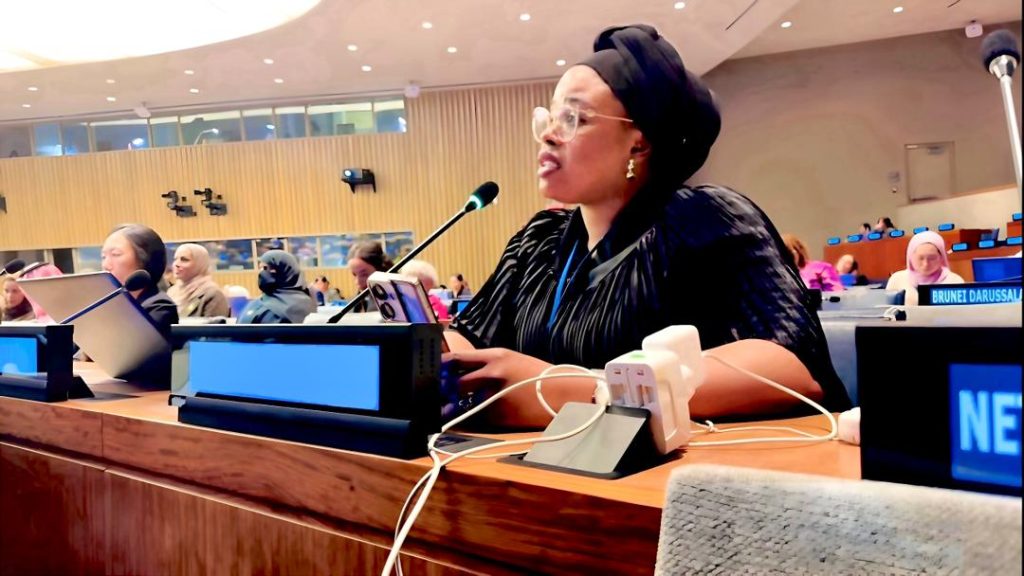
Representing civil society voices from Africa, Founder Aisha Hamman participates in two high
level multi-stakeholder panels dedicated to advancing youth inclusion, accountability and
intergenerational leadership. The discussions explore how governments, UN agencies and
development institutions can ensure that youth engagement moves beyond symbolism and
becomes embedded within governance systems.
Youth Participation as a Structural Governance Priority
Lift Africa Foundation emphasises that youth participation must be institutionalised—not treated as advisory, optional or episodic. The Foundation stresses that young people, particularly those in conflict-affected and marginalised communities, are not consistently represented in processes that shape their futures.
Key gaps identified include:
- youth policies without enforceable mechanisms
- limited financing for youth-led organisations
- bureaucratic barriers to participation
- digital and information inequalities
- shrinking civic space
Lift Africa calls for legal mandates that guarantee youth representation in governance structures, peacebuilding frameworks and national development plans.
From Policy Presence to Practical Inclusion
The Foundation presents evidence showing that despite growing references to youth in policy
documents, many young people remain excluded from decision-making. To address this gap, Lift Africa advocates for:
- youth quotas within national and local decision-making bodies
- financing structures that support long-term youth-led initiatives
- civic identity and justice reforms that remove administrative barriers
- integrated monitoring systems that track youth inclusion across sectors
The Foundation emphasises that youth must be seen as co-authors of solutions, not as
demographic beneficiaries awaiting intervention.
Addressing Inequality in Participation
Lift Africa’s interventions highlight persistent inequalities that shape youth experiences:
- digital inequality restricting access to global platforms
- gender barriers limiting girls’ and young women’s visibility
- underfunded youth spaces constraining organising power
- marginalisation of youth in rural, conflict-affected and low-income communities
The Foundation calls for targeted investment to close these gaps and ensure equitable
engagement.
Intergenerational Co-Leadership and Accountability
Lift Africa advocates for intergenerational co-leadership models that place young people
alongside policymakers, community leaders and senior officials in governance and development planning. The Foundation stresses that accountability frameworks must:
- show who is excluded
- identify why exclusion persists
- track the impact of youth participation on governance outcomes
These mechanisms allow institutions to shift from symbolic engagement to measurable inclusion.
Connecting Global Dialogue to National Realities
Drawing from its work in Nigeria, Lift Africa Foundation highlights how limited civic space,
bureaucratic hurdles, underfunded youth programmes and socio-economic inequality restrict
participation for millions of young people. The Foundation emphasises that the SDGs—
particularly SDGs 4, 5, 10 and 16—cannot advance without structural investment in youth
leadership.
Lift Africa Foundation’s Commitment
Through this global engagement at the United Nations, Lift Africa Foundation reaffirms its
commitment to:
- advancing systemic reforms that guarantee youth participation
- expanding civic space and access to justice for young people
- strengthening youth-led governance and accountability mechanisms
- promoting gender-inclusive youth leadership
- supporting youth-driven solutions across peace, education and development
The Foundation continues to contribute to global policy frameworks with grounded insights from African communities, ensuring that youth perspectives from the Global South remain visible, credible and influential in global decision-making.